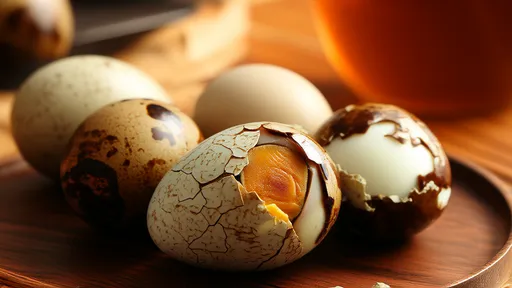
In the quiet predawn hours of a traditional Chinese kitchen, a subtle alchemy unfolds. A pot of ordinary hard-boiled eggs, their shells a pristine white, meets a simmering bath of dark, fragrant tea. But the transformation begins not with immersion, but with a series of delicate, percussive taps. Using the back of a spoon or the handle of a knife, the cook gently cracks each shell, creating a delicate, web-like network of fractures. This is the first and most critical step in creating Cha Ye Dan, or Tea Leaf Eggs, a beloved snack found across East Asia. The artistry of these cracks, however, is far more than mere decoration; it is the very gateway to flavor, a culinary technique where physics and taste converge.
The foundational principle is deceptively simple: the depth and pattern of the cracks directly dictate how deeply the marinating liquid will penetrate the egg white. A shell that remains intact acts as a formidable barrier. While the egg might absorb some color and flavor through its porous shell over an extremely long period, the result is superficial. The goal is not a faintly tan egg, but one with a profound, marbleized beauty and a deeply infused savor. The cracks are the engineered channels that make this possible, bypassing the shell's primary defense.
This process is a practical application of basic scientific principles. The marinating broth—a complex mixture of black tea, soy sauce, star anise, cinnamon, and often other spices like fennel or Szechuan peppercorns—is a solution. The cracks provide a direct path for this solution to come into contact with the semi-permeable membrane just beneath the shell and the coagulated proteins of the egg white itself. Through the mechanisms of diffusion and osmosis, the flavorful compounds in the broth, including salts, amino acids from the soy sauce, and tannins from the tea, migrate from an area of high concentration (the broth) to an area of lower concentration (the egg white). The wider and deeper the fracture, the greater the surface area exposed, and the more efficient this transfer becomes.
However, the true artistry lies in the nuance of the tap. An overzealous crack, one that is too deep and forceful, can be disastrous. It can rupture the thin membrane underneath the shell, causing the egg white to weep out into the broth during the long simmering process. This results in a tough, rubbery egg with a compromised texture and a pot of broth clouded with loose albumin. The perfect crack, therefore, is one that is deep enough to penetrate the calcareous shell decisively but gentle enough to leave the underlying membrane largely intact. This creates a sealed chamber where the broth can seep into the microscopic space between the shell and the egg white, allowing for slow, steady, and deep infusion without leakage.
The pattern of the cracking is equally important. A single large crack offers a limited and uneven pathway. The hallmark of a masterfully crafted tea egg is a fine, all-over craquelure that resembles cracked porcelain or a spider's web. This intricate network ensures that the marinating liquid accesses the egg from all angles, leading to a uniform penetration of flavor and that iconic marbleized effect. As the dark broth seeps through the fractures and stains the egg white, it creates beautiful, dark brown veins against a lighter background, a visual map of the flavor journey within. The pattern is not random; it is a designed delivery system for taste.
The duration of steeping is the final variable in this equation. Even with perfect cracks, time is the essential catalyst. The eggs are typically simmered in the spiced tea broth for hours, and often left to steep overnight as the pot cools. This extended period allows the slow, patient process of infusion to reach its full potential. The cracks, having done their initial job of providing access, continue to act as conduits throughout this entire period. The depth of the crack initially determines the rate of infusion, while the steeping time determines the ultimate depth of the flavor profile. A deep crack combined with a long steep yields an egg where the savory, spiced, and slightly bitter notes of the tea penetrate nearly to the yolk.
Beyond the kitchen, the tea egg is a humble testament to a broader philosophical approach found in many culinary traditions: the idea of creating beauty and depth through intentional imperfection. The Kintsugi philosophy of Japan repairs broken pottery with gold lacquer, highlighting the breaks as part of the object's history. Similarly, the cracks in a tea egg's shell are not hidden; they are celebrated as the very source of its character and complexity. They transform a commonplace ingredient into something extraordinary, proving that what some might see as damage can be ingeniously repurposed into a vehicle for profound flavor.
Ultimately, the making of a perfect Cha Ye Dan is a quiet lesson in patience and precision. It reminds us that the deepest flavors often require a breaking open, a vulnerability to the outside world. The gentle tap of the spoon is a deliberate act of creation, a calculated compromise of structural integrity for a far greater reward. Each crack is a promise of the richness to come, a tiny fracture through which an entire world of aroma and taste will flood, turning the simple egg into a deeply satisfying and beautifully complex culinary icon.
By /Aug 20, 2025
By /Aug 20, 2025
By /Aug 20, 2025
By /Aug 20, 2025
By /Aug 20, 2025
By /Aug 20, 2025
By /Aug 20, 2025
By /Aug 20, 2025
By /Aug 20, 2025
By /Aug 20, 2025
By /Aug 20, 2025
By /Aug 20, 2025
By /Aug 20, 2025
By /Aug 20, 2025
By /Aug 20, 2025
By /Aug 20, 2025
By /Aug 20, 2025

By /Aug 20, 2025
By /Aug 20, 2025
By /Aug 20, 2025
