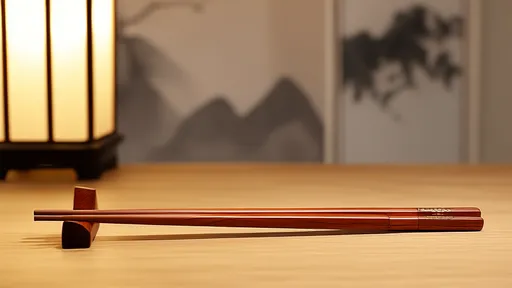
The standard length of chopsticks, precisely seven cun and six fen, is far more than a mere measurement—it is a profound cultural statement. This dimension, roughly equivalent to 25.3 centimeters or about 10 inches, has been preserved across dynasties and borders, echoing a philosophy that extends beyond dining etiquette. While modern variations exist for specific purposes like cooking or serving, the traditional eating chopstick steadfastly adheres to this length, embedding a silent narrative of human nature into every meal shared.
To grasp the significance of seven cun six fen, one must first understand the traditional Chinese units of measurement. A cun is a unit of length that has historically been based on the width of a person's thumb at the knuckle, though it was standardized to approximately 3.33 centimeters. A fen is one-tenth of a cun. Therefore, this specific measurement is intentional and precise, not an arbitrary or rounded number. It reflects a system of thought where numbers carry weight and meaning, where geometry and philosophy are intertwined.
The number seven holds a distinctive place in Chinese culture, deeply rooted in both classical philosophy and everyday belief. It is a number that resonates with the rhythm of life and the cosmos. There are the Seven Stars of the Big Dipper (Bei Dou), a crucial navigational and mythological constellation. In Taoist tradition, the seven apertures of the head (eyes, ears, nostrils, and mouth) connect the inner self to the outer world. This numerological significance provides the foundation for the chopstick's first layer of meaning: the seven emotions (qi qing).
According to traditional Chinese medicine and Confucian thought, the seven emotions are the fundamental human feelings that, in balance, lead to health and harmony, but when in excess, can cause disorder. These are joy, anger, sorrow, fear, love, hate, and desire. They represent the full spectrum of human psychological experience. The chopstick's length serves as a tangible, daily reminder of these inherent emotions. Every time one picks up a pair, it is a subtle nudge toward self-awareness and emotional moderation, a core tenet of cultivating virtue.
Complementing the seven emotions are the six desires (liu yu). This concept originates from Buddhist philosophy, which identifies the desires born from the interactions of our six senses (sight, sound, smell, taste, touch, and thought) with the external world. They are the cravings and attachments that can lead to suffering if left unchecked. The six desires represent our basic instincts and material longings. By incorporating this number into their design, chopsticks become a symbol not just of what we feel, but of what we crave, embodying the entire human condition of sensory experience and temptation.
Therefore, the combined寓意 (yuyi - symbolic meaning) of seven emotions and six desires is a masterpiece of cultural coding. It transforms a simple eating utensil into a instrument of moral and philosophical instruction. It whispers that to be human is to acknowledge these feelings and desires, but also to master them. The act of eating—a fundamental need driven by desire (hunger) and emotion (joy of taste)—is thus framed by the very tools used to perform it. They are a check against gluttony and impulse, promoting mindfulness and temperance with every bite taken.
The design of chopsticks themselves is a lesson in balance and restraint. Their length requires dexterity and skill; they cannot be used to stab or grab large portions greedily. They encourage taking modest, manageable amounts of food, reflecting the virtue of moderation. The fact that they always come in a pair is also deeply symbolic, representing the dualities of life—yin and yang, heaven and earth, the self and the other. Using two sticks in harmony to eat is a practice in achieving balance, cooperation, and control, directly mirroring the philosophical goal of managing one's emotions and desires.
This symbolism is woven seamlessly into the fabric of social and family life. During shared meals, which are central to Chinese culture, these values are passively transmitted. Children learning to use chopsticks are not just learning a practical skill; they are being initiated into a system of values. The dinner table becomes a classroom for Confucian ideals of propriety (li) and harmony. The chopsticks, with their immutable length, act as a constant, unifying standard, reinforcing cultural identity and philosophical continuity from one generation to the next.
When compared to other dining utensils, the cultural weight of the seven cun six fen chopstick becomes even more apparent. The knife and fork, for example, evolved primarily as tools of function and individual portioning, their forms dictated by cutting and spearing. Their symbolism, if any, is often linked to individual power or status. The chopstick, in stark contrast, was shaped by ideology. Its primary function was not just to deliver food, but to do so in a way that embodied a specific worldview centered on collective harmony, emotional balance, and philosophical restraint.
In today's globalized world, the humble chopstick has traveled far beyond its cultural origins. Yet, even as billions of people worldwide use them, the profound symbolism of their traditional length remains a quiet secret, a layer of depth unknown to most casual users. For those who understand, however, it remains a powerful and elegant symbol. It is a testament to a culture that sought to find the profound in the mundane, to embed its deepest understandings of humanity into the objects of everyday life. The seven cun and six fen are not just a measurement; they are a measure of what it means to be human.
By /Aug 20, 2025
By /Aug 20, 2025

By /Aug 20, 2025
By /Aug 20, 2025
By /Aug 20, 2025
By /Aug 20, 2025
By /Aug 20, 2025
By /Aug 20, 2025
By /Aug 20, 2025
By /Aug 20, 2025
By /Aug 20, 2025
By /Aug 20, 2025

By /Aug 20, 2025
By /Aug 20, 2025
By /Aug 20, 2025
By /Aug 20, 2025
By /Aug 20, 2025

By /Aug 20, 2025
By /Aug 20, 2025
By /Aug 20, 2025
